
Summary:
You have probably never thought twice about the unit sitting in your wall. It cools in the summer, heats in the winter, and you mostly ignore it until something goes wrong or until your Con Edison bill arrives in February and makes you question every life decision you have ever made.
Here is the thing: two units that look identical can cost dramatically different amounts to run. One uses electric resistance heat. The other uses a heat pump. The difference between those two technologies is the difference between a manageable heating bill and an expensive one. If you are in Queens, that gap is bigger than almost anywhere else in the country.
What Is The Difference Between A PTAC And A PTHP?
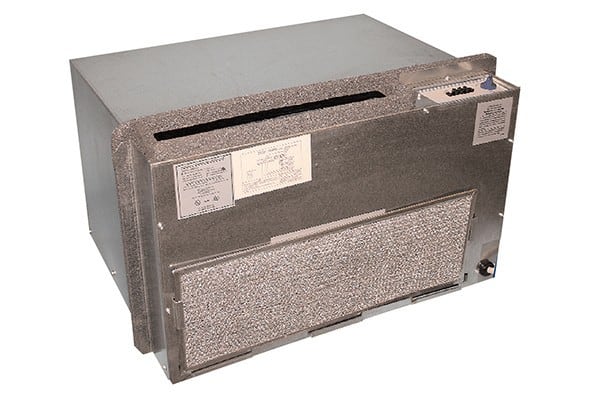
A PTAC, which stands for packaged terminal air conditioner, is the through-wall unit you will find in apartment buildings, hotels, and older co-ops all across Queens. It handles both heating and cooling in one self-contained box. A PTHP is the same physical unit with one critical difference: it uses a heat pump for heating instead of electric resistance coils.
From the outside, you cannot tell them apart. Same dimensions, same sleeve, same controls. The distinction is entirely in how they generate heat, and that is where the cost story begins.
Electric resistance heat is about as straightforward as heating gets. Electricity flows through a coil, the coil gets hot, and that heat moves into your room. It is reliable, simple, and works in any temperature. It is also the least efficient way to heat a space that exists.
The technical term for this is COP, meaning coefficient of performance. For electric resistance heat, the COP is always exactly 1.0. That means for every unit of electricity you put in, you get exactly one unit of heat out. No more, no less. There is no mechanical advantage. You are converting electricity to heat at a one-to-one ratio every hour the unit runs.
In most parts of the country, this is an inconvenience. In New York City, where Con Edison residential electricity rates are among the highest in the nation, it is an expensive problem. To produce 12,000 BTU of heat, which is roughly what you would need to heat a standard Queens apartment room, a resistance-heat PTAC consumes about 3.52 kilowatt-hours of electricity per hour. Run that unit through a cold January night, and the meter is spinning the entire time at full draw.
The reason this matters so much in Queens specifically is that the buildings most likely to have these units, such as pre-war walk-ups in Astoria, mid-century apartment buildings in Rego Park and Forest Hills, and older co-ops in Jackson Heights, were built long before anyone was thinking about energy efficiency at the unit level. The electric resistance PTAC was the standard, and in many buildings it still is. Most tenants and even many building managers have no idea their unit is running at COP 1.0 because nobody ever told them there was another option.
A PTHP does not generate heat the way a resistance coil does. Instead, it moves heat by pulling warmth from the outdoor air and transferring it inside. This is the same principle behind a refrigerator running in reverse, and it is far more efficient than converting electricity directly into heat.
The COP for a PTHP in heat pump mode typically ranges from 2.5 to 3.6 under normal operating conditions. NYC HPD and NYSERDA have described PTHPs as three times as efficient as electric resistance systems. What that means practically is that to produce the same 12,000 BTU of heat that costs a resistance-heat PTAC 3.52 kWh per hour, a PTHP running at a COP of around 3.2 uses approximately 1.10 kWh per hour. That is not a marginal improvement, as it is a fundamentally different relationship between electricity and heat.
At Con Edison rates, that gap translates into real money, not abstract percentages on a spec sheet, but dollars on your monthly bill. Research consistently shows that switching from electric resistance to a heat pump PTAC cuts heating costs by 30 to 50 percent. In a market with NYC electricity prices, that range is on the conservative side.
The other thing worth knowing: a PTHP never leaves you without heat. When outdoor temperatures drop below the efficient operating range for the heat pump, typically below 30 to 35 degrees Fahrenheit, the unit automatically switches to its built-in electric resistance backup. You do not have to do anything. The transition is seamless. On the coldest nights in February, the backup kicks in. But those nights represent a fraction of the total heating season. The vast majority of fall, winter, and spring in Queens falls in the temperature range where the heat pump runs efficiently, and that is where the savings accumulate.
One more thing that surprises most people is that you almost certainly do not need to touch your walls. The standard wall sleeve used in Queens apartment buildings, measuring 42 inches wide by 16 inches high, is the same sleeve that accepts a PTHP replacement unit from every major manufacturer. In most cases, swapping a resistance-heat PTAC for a PTHP is a slide-in replacement, not a construction project. The barrier most people imagine does not exist.
Why The PTAC vs PTHP Decision Hits Differently In Queens
Every national comparison of PTAC versus PTHP uses average electricity rates to calculate savings. Queens is not an average electricity market. Con Edison rates are among the highest in the United States, which means the efficiency gap between a COP 1.0 resistance unit and a COP 3.0+ heat pump is amplified here in a way that generic calculators do not capture.
For building managers overseeing 10, 20, or 50 units in a Queens apartment building, that amplification is the whole story. The math that looks interesting in a national context looks urgent when you are paying Con Edison prices for every hour of resistance heat running across an entire floor.
This is the question we hear most often, and it is a fair one. Heat pumps have a reputation for struggling in cold weather, and if you have heard that before, you have heard something that is true in extreme climates, but not particularly relevant to Queens.
NYC’s average January low is around 26 to 28 degrees Fahrenheit. Most PTHPs operate in heat pump mode efficiently down to about 30 to 35 degrees. So yes, there are nights, such as the deep cold snaps in late January and early February, when the unit will switch to backup resistance heat. But those nights are a small fraction of the total heating season. From October through April, the majority of hours fall in the range where the heat pump runs efficiently and the savings accumulate.
The honest answer is that New York City is in the sweet spot for PTHP performance. It is cold enough that heating costs matter significantly, but not so extreme that heat pumps lose their advantage. Alaska is a bad heat pump climate. Queens is not. The resistance backup is there for the rare occasions when you need it, and the heat pump does the heavy lifting the rest of the time.
NYSERDA specifically studied the New York State PTAC and PTHP market and identified more than 100,000 units across the state that could be upgraded to high-efficiency PTHPs without any exterior wall modifications. They did not include NYC in that analysis as a footnote, as they analyzed it as a distinct, significant market segment. Queens building owners are exactly who that finding was about.
If you own or manage a building in Queens that exceeds 25,000 square feet, the PTAC versus PTHP decision is not only about heating bills. It is also about compliance. NYC Local Law 97 sets mandatory carbon emissions limits for large buildings, with penalties that began in 2024 and tighten significantly in 2030. PTHP conversion is explicitly a Clean Heat-eligible upgrade and a recognized compliance pathway under the law.
That matters because it reframes the economics. You are not just comparing the cost of two different units. You are comparing the cost of upgrading against the cost of non-compliance, which is a different calculation and one that increasingly favors the upgrade.
There is also a financial incentive that many Queens building owners do not know about. Through ConEdison’s Multifamily Buildings Neighborhood Programs, which specifically cover Brooklyn and Queens, qualifying buildings may be eligible for incentives covering up to 100 percent of total measurable upgrade costs. The NYSERDA Room Heat Pump Program also vets specific manufacturers of through-wall heat pumps designed to replace PTACs in standard wall sleeves, a program that exists precisely because the NYC multifamily market is large enough to warrant dedicated support.
The combination of Local Law 97 compliance pressure and available ConEdison and NYSERDA incentives means that for Queens building owners, the financial case for upgrading to PTHPs is stronger than it appears on paper. The upfront cost is real, but the regulatory risk of staying with resistance heat is also real, and the incentive programs exist specifically to help close the gap.
If you are not sure if your building qualifies, or which units in your portfolio would benefit most from a swap, that is the kind of assessment we have been doing for buildings across Queens and the rest of New York City for more than 50 years.
So, PTAC Or PTHP: What Is The Right Call For Your NYC Building?
If your building is running electric resistance PTACs and you are in Queens, you are paying more than you need to every single winter. The technology to change that fits in the same wall sleeve you already have, and the savings, which range from 30 to 50 percent on heating costs at Con Edison rates, are not a marketing claim. They are the result of a fundamental difference in how these two units work.
The PTHP is the right call for most Queens buildings and apartments. The climate supports it, the building stock is compatible with it, and the regulatory and incentive environment in NYC makes the economics more compelling here than almost anywhere else.
If you are not sure what type of unit you currently have, or you want to understand what a swap would involve for your building, contact Lion Enterprises of New York, LLC today to schedule your expert PTAC evaluation and get a straight answer on where your system stands.